Results at a glance
One classifier pass instead of a frontier-LLM call
AppWorld tool shortlisting, per decision: TabAgent's head against the GPT-5.4 shortlister it replaces. From the paper.
| Decision | Benchmark | Metric | Best baseline | TabAgent | Reproducible here |
|---|---|---|---|---|---|
| Tool shortlisting | AppWorld, five apps | P@R | 56–92 | 66–96 | traces not released |
| Tool shortlisting | τ²-bench, three domains, 38 tools | P@R | 42 | 78 | ✓ |
| Skill shortlisting | SkillsBench, 195 skills | P@R | 74 | 80 | ✓ |
| Application selection | AppWorld, multi-label | macro‑F1 | 92 | 97 | traces not released |
| Operation selection | Mind2Web, three-way | macro‑F1 | 84 | 92 | ✓ |
| GUI element selection | Mind2Web, three domains | R@3 | 15–23 | 68–74 | ✓ |
| Model routing | LLMRouterBench, 12 models | route@1 | 70 | 71 (on par) | ✓ opt-in download |
How to read this table
Percentages from the paper's Table 1 and, for AppWorld, its full per-method table. TabAgent is the better of its real-only and +synth variants. Best baseline is the strongest of BM25, DSR (zero-shot and fine-tuned; on AppWorld also fine-tuned on the same TabSynth rows, where TabAgent's lead is significant only on Gmail) and the few-shot LLM in each row; on model routing it is the best single model applied to every task. A fine-tuned 8B small LLM, a reference at about 10²–10⁴× TabAgent's cost, is excluded as in the paper; it scores higher on four of the five AppWorld apps. The AppWorld rows use the CUGA agent's own trajectories, which are not released. The paper's table also covers the OAK and BPO enterprise benchmarks, where the small trajectory pools leave TabAgent behind or level with the best baseline, and sub-agent routing and skill gating, where it is on par with the best fixed default. Reproducing the paper recomputes every public row.
The reproducible rows run on the feature cards bundled with each public dataset, not on a new TabSchema run, so
reproducing them calls no LLM. A card is frozen when its feature list was taken from the paper's experiment
code for that benchmark and fixed, every feature recomputed by the release's code (a few frozen cards are
variants; each card's provenance note says how), and hand-authored when it was written for the release from
the paper's description of the benchmark's features (provenance.kind in each card). The released TabSchema
implementation has not yet been validated against a paper number.
Quick start
Install, onboard, decide
pip install tabagent                # core: tables, TabSynth, TabHead, evaluation
pip install "tabagent[tabschema]"   # + onboarding from agent logs (OpenAI and OpenAI-compatible LLMs)
pip install "tabagent[llm]"         # + Anthropic, Gemini and other providers through LiteLLM
pip install "tabagent[serve]"       # + the HTTP decision service
Python 3.10 to 3.13. Until the PyPI release, install from GitHub:
pip install "tabagent @ git+https://github.com/dolev31/TabAgent".
export OPENAI_API_KEY=...                                     # the LLM TabSchema calls
tabagent scan ./agent_logs                                    # which LLM calls are worth replacing?
tabagent onboard ./agent_logs --decision ToolShortlist --dry-run   # what it will process and cost
tabagent onboard ./agent_logs --decision ToolShortlist --out ./my_head
tabagent serve ./my_head --port 8077                          # POST /decide
from tabagent import TabAgentRanker

# one row per (decision, candidate); y = 1 if the agent chose the candidate
ranker = TabAgentRanker(group_col="task_id", candidate_col="tool")
ranker.fit(X, y)  # infers the card, picks TabSynth and the prior by nested validation
ranker.rank(X_new, k=5)  # top-5 candidates per decision
Or run the quickstart in your browser: 
Use it in your agent
Onboard, serve, hot-swap
Onboard from logs
tabagent onboard reads the agent's own logs (OpenAI, Anthropic, LangChain, τ²-bench, CUGA or generic JSON),
discovers the features with TabSchema, and saves a head with a reviewed, hash-pinned extractor.
Serve it
tabagent serve answers POST /decide from warm, sandboxed workers, defers a decision whose extraction runs late,
and exposes readiness, Prometheus metrics and feature-drift monitoring.
Hot-swap the LLM call
ToolFilter sends your tool-calling LLM only the tools the head shortlists, and the full list whenever the head
defers. The surrounding agent is unchanged.
from tabagent.integrations.openai_tools import ToolFilter

tool_filter = ToolFilter("my_head", k=7)  # or the URL of a `tabagent serve` service
session = tool_filter.session(task={"instruction": goal})  # one per conversation
client.chat.completions.create(model=..., messages=messages, tools=session(messages, tools))
What the paper finds
The representation, not the model
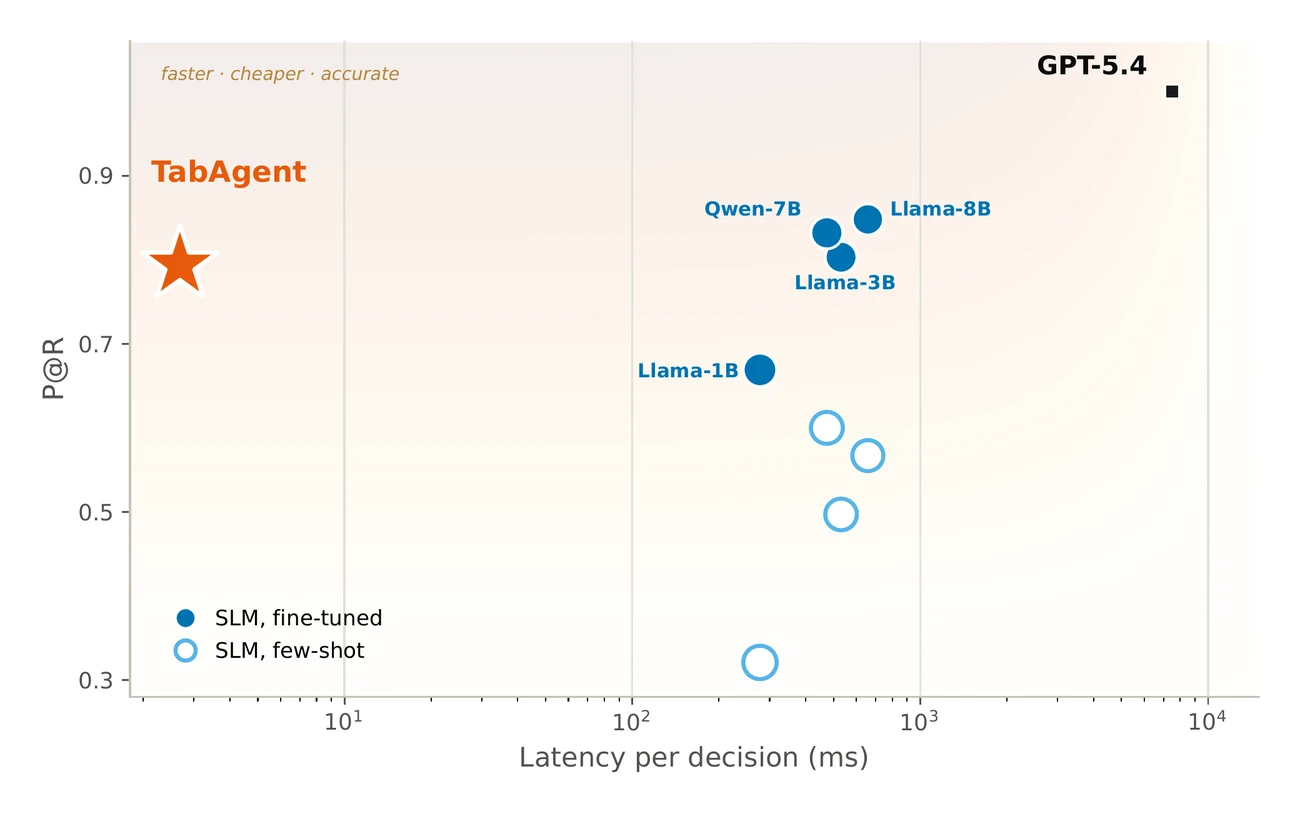
Across three decision families and seven agent benchmarks:
- Set retrieval. On AppWorld tool shortlisting, TabAgent recovers essentially all of the tools the GPT-5.4 shortlister used on its successful runs (Recall@9) at far lower latency and cost.
- Classification and policy. It ranks first on the classification decisions and is on par with a strong fixed default on the harder routing and gating decisions, where a costly generative router does worse.
- Representation, not model. A discriminative head over raw text or embeddings alone collapses; the trace-derived features make it accurate.
- In the loop. Placed on a live agent's critical path, TabAgent drives AppWorld tasks to completion about as often as the GPT-5.4 shortlister it replaces.
- Few traces. The head reaches 90% of its full-pool P@R from 118 successful trajectories on AppWorld and from 37 to 51 on the four τ²-bench agents.
Go deeper
Guides
-
The decision table, the four decision kinds, leakage safety, the evaluation protocol.
-
TabSchema, TabSynth and TabHead in detail.
-
Log formats, privacy and cost controls, reviewing the generated extractor.
-
The scikit-learn estimators and automatic recipe selection.
-
Saved heads, the HTTP service, the tool filter, the confidence gate.
-
Every public dataset, its pinned source, license and the paper result it backs.
-
Each paper cell, the command that recomputes it, paper vs released values.
-
Five runnable scripts, from the public-benchmark quickstart to cross-agent transfer.
The paper
Abstract
Agentic systems chain LLM calls to make closed-set decisions: choosing from a fixed candidate set, as in skill selection, tool shortlisting, application selection, and routing. These repeated frontier-model calls dominate per-task latency and cost. We show such decisions need not be made by a language model at all: a compact discriminative head, trained on the agent's own successful execution traces, can replace the generative one while leaving the surrounding agent intact. TabAgent has three parts. (i) TabSchema extracts schema, state, and dependency features from trajectories. (ii) TabSynth adds schema-aligned synthetic rows where trajectory coverage is thin. (iii) TabHead, a cheap tabular classifier, scores candidates in a single pass. Changing only the label space, we test TabAgent as a drop-in replacement for the frontier-LLM heads (e.g., GPT-5.4) across three decision families and seven agent benchmarks. On tool shortlisting it recovers essentially all of the tools the GPT-5.4 shortlister used on its successful runs (Recall@9), at 99.96% lower latency and 99.9996% lower cost per call (∼10³× and ∼10⁵×). It also ranks first on the classification decisions and is on par with a strong fixed default on the harder routing and gating decisions at far lower latency and cost, where a costly generative router does worse. Across these tasks, the gains come from the representation, not the model: a discriminative head over raw text or embeddings alone collapses, and trace-derived features make it accurate.
The paper on arXiv: abstract page · PDF. Its first version (v1, February 2026) carries the paper's earlier title, TabAgent: A Framework for Replacing Agentic Generative Components with Tabular-Textual Classifiers.
Key terms
- Closed-set decision
- A decision inside an agent's execution whose answer is selected from a fixed, bounded set of candidates: which skill to invoke, which tool to call next, which application to route to, or which sub-task to gate.
- Tool shortlisting
- The task of picking a small subset from a catalog of hundreds to thousands of tools, where a tool is any externally callable capability (API endpoint, function, or GUI operation) with a typed schema and observable outputs.
- Feature card
- The tabular layout TabAgent learns from, with one row per (context, candidate) pair and one column per behavior-grounded feature.
- TabSchema
- An orchestrated agentic system that proposes features, implements them as executable trace-extraction code, and keeps only those a judge ensemble agrees are decision-relevant.
- TabSynth
- A schema-aligned augmentation module: a deterministic, rule-based paraphraser that rewrites the free-text state of an existing training row while copying the candidate, the label, and every schema, state, and dependency feature verbatim.
- TabHead
- The classifier that scores each (context, candidate) pair over the TabSchema feature card in a single pass. It is CatBoost in every main-paper result.
- P@R (R-precision)
- The share of a task's ground-truth tools that appear in the top R of the ranking, where R is the task's relevant-set size, averaged over tasks. It equals Recall@R and captures completeness.
- Recall@k
- The share of a task's ground-truth tools recovered in the top k of the ranking, averaged over tasks: recovery at a fixed budget.
FAQ
Questions
Can a small classifier replace an LLM for tool selection in an agent?
For closed-set decisions an agent makes repeatedly, the paper shows it can. TabAgent trains a CatBoost classifier on the agent's own successful traces. On AppWorld tool shortlisting it recovers essentially all of the tools GPT-5.4's successful runs used (Recall@9 of 92 to 100 across five apps) at 2.682 ms and $2.0×10⁻⁷ per decision, against 7.50 s and $0.052 for the GPT-5.4 shortlister.
What is TabAgent?
TabAgent is a framework that replaces a generative decision head in a running LLM agent, such as a tool shortlister or a router, with a compact classifier trained on the agent's own successful execution traces. TabSchema turns the traces into a tabular feature card, TabSynth adds paraphrased rows where coverage is thin, and TabHead (CatBoost) scores every candidate in one pass. The surrounding agent is left unchanged.
What exactly does TabAgent learn from?
From the agent's own successful execution traces. TabSchema turns them into a tabular feature card: each row is a (task context, candidate tool) pair, each column a behavior-grounded feature (for example, the agent's current thought, the step index, or whether the candidate has co-occurred with other tools in similar traces), and the label is whether the successful trajectory used the candidate. TabAgent learns the decision boundary of the generative head from these rows and runs that boundary as a single-pass classifier in place of the LLM.
Which decisions can TabAgent replace?
Closed-set decisions, whose answer comes from a fixed set of candidates. The paper covers three families across seven benchmarks: set retrieval (tool and skill shortlisting on AppWorld, τ²-bench, OAK, BPO and SkillsBench), classification (application selection on AppWorld, operation and GUI element selection on Mind2Web), and policy or reward decisions (sub-agent routing on AppWorld, model routing on LLMRouterBench, and skill gating on SkillsBench).
Does the classifier head matter?
Little. With the skill-selection feature card held fixed, heads from classical trees to tabular foundation models such as TabPFN and TabSTAR reach useful and comparable P@R on skill selection, and every head collapses to P@R 0.10 to 0.21 without the card. The gains come from the trace-derived representation, not the model, which is why one lightweight CatBoost head serves every decision family in the paper.
Does TabSynth always help?
Not always. On AppWorld, TabSynth lifts TabAgent P@R by 23% on average, concentrated in domains where limited trajectory coverage causes the shortlister to miss required selections (SimpleNote +55%, Phone +36%). It is not universally positive: on Spotify it lowers P@R (70 → 61), which the paper attributes to a small trajectory pool and strong lexical cues that turn paraphrase diversity into noise rather than coverage. The paper therefore applies +synth per card and reports the head that wins.
How does TabAgent hold up as the number of candidates grows?
Its margin widens as the candidate set grows. As the candidate-set size K grows, every LLM adaptation regime (generative SFT, cross-encoder, and few-shot) degrades sharply on both skill selection and Mind2Web element selection, while the TabAgent classifier follows a shallow power law (R² ≥ 0.97) and stays highest at every measured K. TabAgent scores each candidate against fixed trace-derived features, so the per-candidate cost is constant and the total cost grows only linearly in the number of candidates, unlike an LLM that must reason over the entire option list in-context, whose prompt grows with the catalog and can exceed 100K tokens for the closed-set options alone.
How many trajectories does TabAgent need?
On AppWorld, TabHead reaches half of its full-pool P@R from 8 successful trajectories and 90% from 118. On the four τ²-bench agents it reaches 90% from 37 to 51. Onboarding therefore costs tens to low hundreds of successful traces rather than thousands. With no trajectories for a domain it cannot be applied, since there is nothing to mimic.
What happens when the agent's prompt or base model changes?
When the upstream agent's behavior shifts (a new prompt, a new base model) but its trace schema is unchanged, only TabHead is refit on the new traces, which takes about 45 seconds on CPU, so drift adaptation does not require a re-engineering pass. A change that alters the feature schema itself requires re-running the one-time TabSchema and TabSynth onboarding.
Does replacing the shortlister hurt task success in a live agent?
In the paper's live hot-swap on 24 held-out cross-application AppWorld tasks, with the CUGA agent driven by GPT-5.4 in both arms, TabAgent reached 27.1% Pass@1 against 29.2% for the GPT-5.4 shortlister. The paired difference of -2.1 points has a 95% bootstrap CI of [-18.8, +16.7], which includes zero. The two configurations agree on the pass-or-fail verdict for 79% of tasks.
Does a model trained on one agent's traces work for another agent?
Within one architecture, yes. On τ²-bench, four ReAct agents share one scaffold and differ only in the LLM backbone. Training on one agent's traces and testing on another's costs about 3.1 points of P@R on average (own-agent mean 0.766, cross-agent mean 0.735). The paper states this is transfer within an architecture, not evidence that TabAgent is architecture-agnostic.
When should the LLM still make the decision?
When the domain has no trajectory pool, when the agent architecture changes, and when the head is unsure. TabHead's confidence flags its own errors at AUROC 0.88, so a confidence gate can defer low-confidence decisions to the original LLM. The paper does not claim TabAgent beats the LLM everywhere: the frontier model is retained where it still earns its cost.
Cite
Citation
If you use TabAgent, please cite the paper:
@misc{levy2026tabagent,
  title  = {TabAgent: Distilling LLM Agent Components into Cheap Classifiers},
  author = {Levy, Ido and Shlomov, Segev and Yaeli, Avi and Mashkif, Nir and Adi, Asaf and
            Goldstein, Yinon and Shapira, Eilam and Choshen, Leshem},
  year   = {2026},
  eprint = {2602.16429},
  archivePrefix = {arXiv},
  primaryClass  = {cs.CL},
  doi    = {10.48550/arXiv.2602.16429},
  url    = {https://arxiv.org/abs/2602.16429}
}